The Invisible Architecture of Your Life
Each morning when you wake up and step into your day, you are building something. Whether you realize it or not, you are laying bricks. Those bricks are habits. And over time, those habits become your structure.
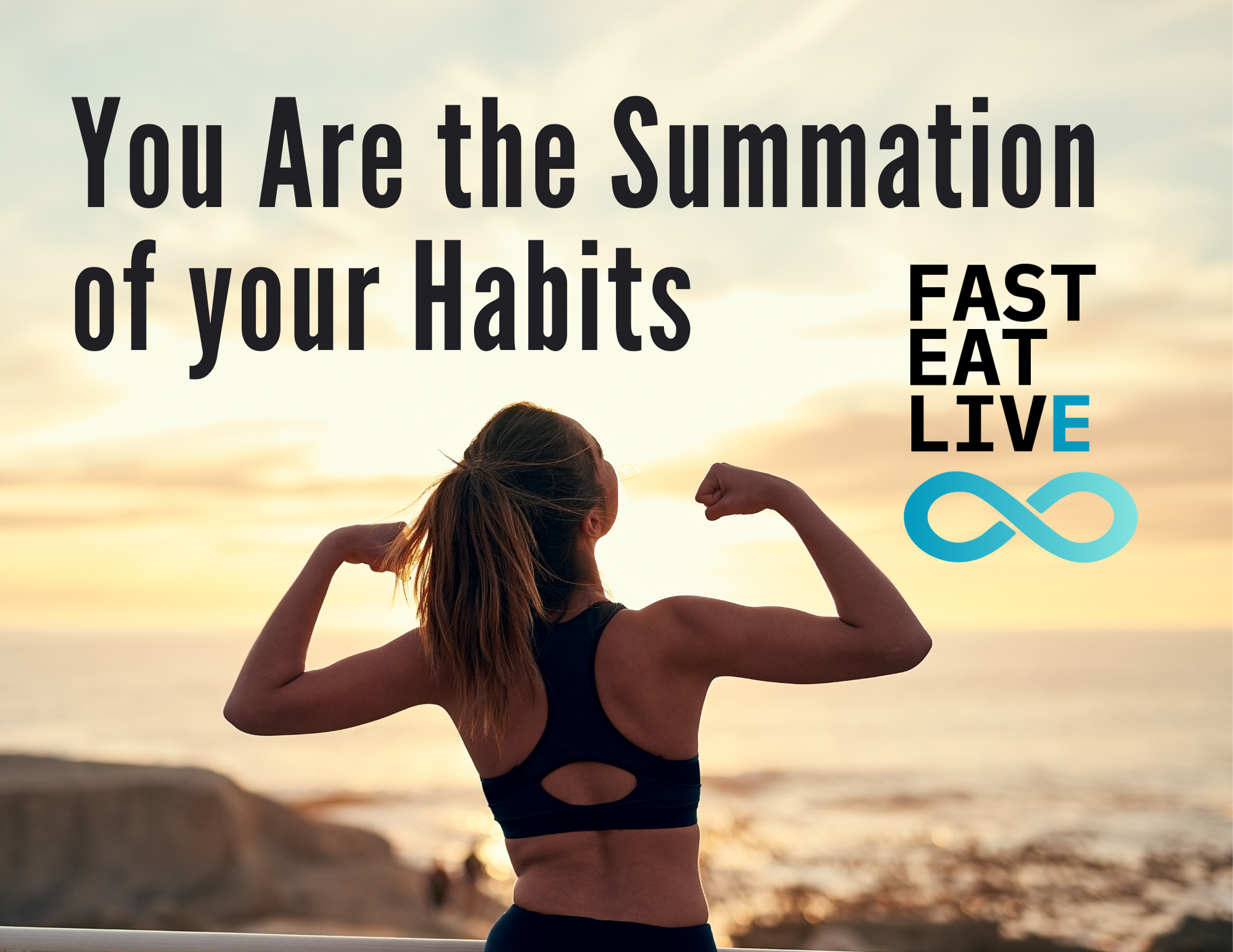
You are the summation of your habits.
That statement is both humbling and empowering. It means your current body, your current mindset, your current energy level, your current relationships, even your current faith discipline — are largely the accumulation of repeated behaviors. There is randomness in life. There is chance. There is favor and there are storms. But the one variable you consistently control is your habits.
As health and wellness coaches inside Fast.Eat.Live., this is where we live. We don’t just hand people meal plans. We help them understand, change, and reinforce habits daily. Because if you want to lose weight next year, build muscle, get stronger, feel better, increase longevity, or genuinely experience more happiness, your daily habits will either carry you there — or quietly sabotage you.
Your paradigm today is primarily the summation of your habits to date.
Results Are a Lagging Indicator
At Fast.Eat.Live., we often say, “This month’s choices are next month’s body.” There is no truer statement.
Results are a lagging measure of behavior. You don’t see the effect immediately. That’s what makes habits so deceptive.
If you consistently consume more calories than you require for energy over the course of a month, your body will store the excess as fat. If you repeat that behavior for six months, the result becomes visible. If you repeat it for five years, it becomes your new identity.
On the other hand, if you strength train consistently for months, prioritize protein, walk daily, and respect Phase 1, 2, and 3 rhythms, you may not see dramatic change in two weeks — but six months later, your body composition, energy, hormones, and confidence look entirely different.
Actions compound. Habits accumulate. Outcomes eventually reveal what was happening all along.
The body always keeps score.
Food Is Information
One of the core teachings inside FEL is this: food is not just calories — it is information.
Every time you eat, you are sending a message to your body about what to do next.
Eat refined carbohydrates and you flood your bloodstream with glucose. Your pancreas releases insulin to manage it. Repeat that cycle frequently enough, and you begin shifting toward fat storage and insulin resistance.
Eat high-quality animal protein and your body receives amino acids to rebuild muscle tissue, strengthen connective tissue, support immune cells, and preserve lean mass.
Drink caffeine and you stimulate your central nervous system. Cortisol rises. Alertness increases.
Drink alcohol and you suppress inhibition, alter neurotransmitters, and shift liver metabolism toward detoxification instead of fat burning.
Food is not neutral. It signals. It instructs. It directs.
This is why we coach that not all calories are created equal. Yes, total energy matters — but hormonal signaling matters too. The quality of your intake influences the quality of your output.
Daily, weekly, and monthly inputs add up.
And eventually, they show up.
The Problem with Habits: The Feedback Loop Is Slow
Here’s where most people struggle.
The feedback loop is too long.
Coming home from work and pouring a glass of wine might relax you immediately. It may soften stress. It may feel deserved. If you repeat that behavior nightly, it becomes normal. The short-term reward reinforces the habit.
But the long-term cost may not show up for years.
The same pattern exists with late-night scrolling, skipped workouts, ultra-processed snacks, chronic sleep deprivation, or avoiding difficult conversations. The present reward feels good. The future consequence feels distant.
Now flip it.
Waking up early to train when you’re tired feels uncomfortable now. Choosing protein over pastries feels restrictive in the moment. Going to bed on time instead of watching another episode feels disciplined.
But those habits produce long-term strength.
James Clear, in Atomic Habits, says it perfectly: “The cost of good habits is in the present. The cost of bad habits is in the future.”
That’s wisdom.
And it aligns beautifully with Scripture. Galatians 6:7 reminds us that we reap what we sow. Seeds planted consistently — good or bad — eventually grow.
You don’t escape the harvest.
Habits Shape Identity
Here’s something powerful to understand habits don’t just shape your outcomes. They shape your identity.
If you train consistently, you begin to see yourself as someone who trains. If you prioritize protein daily, you begin to see yourself as someone who fuels with intention. If you pray daily, you become someone anchored spiritually.
Identity reinforces behavior.
Behavior reinforces identity.
This is why inside Fast.Eat.Live., we focus on rhythm rather than restriction. Phase 1 (Fast), Phase 2 (Eat), and Phase 3 (Live) are not about willpower contests. They are about identity formation. You are becoming someone who respects metabolic flexibility. You are becoming someone who balances discipline and celebration. You are becoming someone who honors the temple without isolating from community.
That identity shift is more powerful than any short-term diet.
The FEL Framework for Habit Mastery
Inside Fast.Eat.Live., we don’t chase perfection. We build repeatable systems.
Phase 1 – Fast: One intentional weekly fast trains metabolic flexibility and mental discipline. It teaches your body that it can function without constant intake. It strengthens both physiology and resolve.
Phase 2 – Eat: High-protein, lower-carbohydrate structure days reinforce muscle retention, hormonal stability, and satiety. This phase builds your frame and sharpens appetite control.
Phase 3 – Live: Balanced macronutrients, shared meals, and celebration remind you that life is meant to be enjoyed. Sustainability requires joy. Discipline without fellowship leads to burnout.
This rhythm becomes a habit architecture. Over time, it compounds into strength, leanness, and clarity.
Mechanisms for Success
If you have goals this year — whether physical, spiritual, or relational — here are some of our favorite mechanisms for reinforcing healthy habits.
First, build partnerships. Surround yourself with friends, family, or a tribe that shares similar goals. Accountability works. Encouragement works. Community multiplies discipline when motivation fades.
Second, consider hiring a coach. The act of investing financially creates commitment. A coach provides wisdom, structure, and accountability. Most people don’t fail because they lack information. They fail because they lack reinforcement.
Third, create visual cues. A handwritten storyboard with goals, images, Scripture, or reminders of why you started is powerful. The brain responds to repetition and visualization.
Fourth, build healthy reward systems. Dopamine isn’t evil — it’s directional. Celebrate progress. Track workouts. Check off protein targets. Replace destructive rewards with constructive ones.
Habits thrive on reinforcement.
You Are Building Something
Whether you are intentional or not, you are building something right now.
If you feel stuck, remember this: you don’t need to overhaul your life overnight. You need to adjust one habit and repeat it long enough for it to become automatic. Small hinges swing big doors.
The beautiful part is this — God designed the brain to change. Neuroplasticity means you are not fixed. You are adaptable. You are moldable. You can renew your mind, as Romans 12:2 teaches, and that renewal shows up in behavior.
Your future self is being shaped by what you repeatedly do today.
Weak Habits or Strong Habits — The Choice Is Daily
There is randomness in life. But your habits are within your control. You cannot control every storm, but you can control your preparation.
Strong habits produce strong bodies.
Strong habits produce stable emotions.
Strong habits produce disciplined faith.
And over time, those strengths compound into happiness — the kind rooted in alignment, not impulse.
If you need help building those rhythms, the Fast.Eat.Live. system exists for exactly that reason. The app, the tribe, the structure — it’s all there to help you win the daily battle so you can enjoy the long-term victory.
Remember this:
This month’s choices are next month’s body.
This year’s habits are next year’s life.
Build wisely, Livsters.
— Coach Scott