How Your Gut Microbiome May Influence Energy, Mood, Immunity, and the Way You Age
By Coach Scott Jansen
A hundred years ago, if a farmer wanted a healthier crop, he did not begin by polishing the leaves. He started with the soil. The old farmers understood something modern culture occasionally forgets what grows above the surface is usually a reflection of what is happening underneath it. Rich soil produced strong plants. Depleted soil produced weak ones. The visible result was often determined long before the first green shoot ever appeared.
After more than three decades of coaching people through weight loss, fitness, health scares, bad habits, better habits, and the occasional “Coach, I only ate one cookie” confession that somehow involved the entire sleeve, I have come to think of the human body in a similar way. We tend to focus on what we can see. The scale. The waistline. The lab numbers. The mirror. The energy crash at 3:00 p.m. that makes a person believe the breakroom vending machine has been personally sent by the Lord as provision.
Those things matter, of course. But they are not always the root. Much like a farmer looking at a struggling crop, we sometimes need to look beneath the surface. Beneath our symptoms, cravings, inflammation, fatigue, digestion, immune resilience, and even mood, there is an internal environment that may be influencing far more than we once imagined.
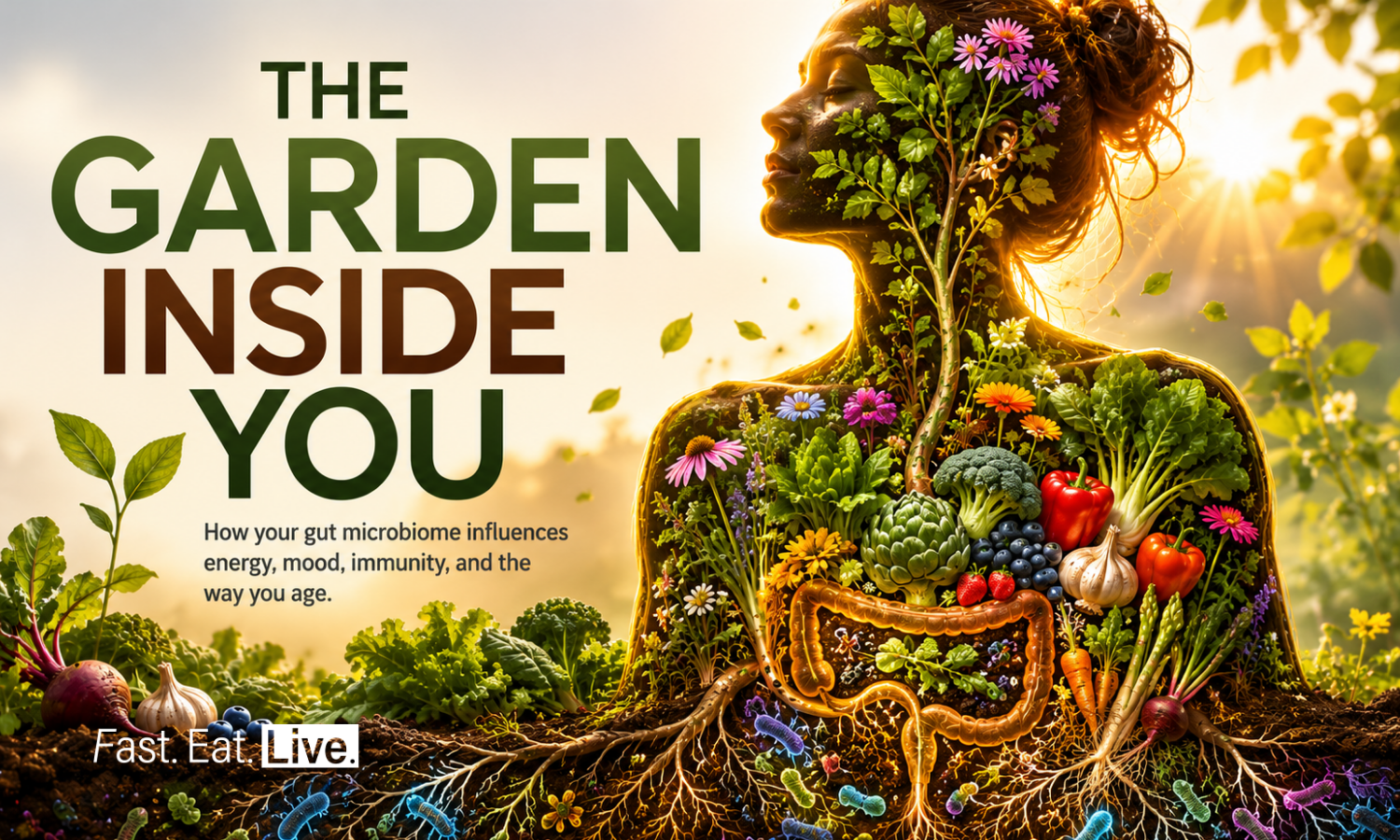
That environment lives largely inside the digestive tract. Scientists call it the gut microbiome. I like to call it the garden inside you.
The comparison is not perfect, but it is useful. A garden can be diverse, resilient, and full of life. It can also become neglected, depleted, and overrun with weeds. In the same way, the microbial ecosystem inside the gut can become rich and varied, or it can become narrow and imbalanced. What makes this so fascinating is that the gut is no longer viewed as merely a digestive tube. The National Institute of Environmental Health Sciences describes the microbiome as the collection of microbes, including bacteria, fungi, viruses, and their genes, that live on and inside us and contribute to health in ways that include immune development, pathogen protection, and digestion of food for energy.
For much of modern medical history, the gut was treated like plumbing. Food went in, nutrients were absorbed, waste came out, and everyone tried not to discuss the details at dinner. That explanation was not exactly wrong, but it was incomplete in the way calling a tractor “a seat with wheels” is incomplete. Technically true, but not the kind of description that helps you run a farm.
Modern microbiome research has revealed that the digestive tract is more like a bustling biological community. Trillions of microorganisms live there, communicating with one another, interacting with the immune system, influencing the gut lining, transforming food compounds, and producing metabolites that can travel through the body. The NIH Human Microbiome Project was created to help characterize these microbial communities and understand their role in human health and disease, which gives you a sense of how seriously the scientific world now takes this once-overlooked ecosystem.
This is one of the reasons I believe gut health belongs in the larger Fast.Eat.Live. conversation. We are not simply trying to help people lose weight. Weight loss is important for many people, but the deeper goal is to help them become healthier, stronger, more resilient human beings. When the gut ecosystem improves, it may support many of the same outcomes we care about inside FEL: better metabolic health, improved energy, stronger immunity, reduced inflammation, steadier mood, and healthier aging.
That does not mean the microbiome is magic. I am always cautious when one area of health suddenly becomes the explanation for everything. In the fitness world, we have seen this movie before. First, everything was fat. Then everything was carbs. Then everything was hormones. Then everything was inflammation. Now everything is the microbiome. Human beings love a single villain almost as much as they love a miracle product.
The truth is usually more interesting. The microbiome is not everything, but it appears to touch almost everything. That makes it worth understanding.
One of the most important words in this discussion is diversity. A healthy garden is rarely made of one plant. A resilient prairie is not built from one grass. A thriving forest depends on thousands of relationships, many of which remain invisible to the casual observer. The same principle appears to apply to the gut. Researchers studying traditional populations have repeatedly found that microbial diversity can be higher in groups eating less industrialized diets. One well-known study of the Hadza hunter-gatherers of Tanzania found higher microbial richness and biodiversity compared with Italian urban controls, suggesting that lifestyle and diet may play a major role in shaping the gut ecosystem.
This matters because modern diets often produce the opposite pattern. Many Americans eat the same small rotation of foods week after week. Breakfast might be sweetened coffee and a protein bar. Lunch might be a sandwich, chips, and a diet soda. Dinner might be something beige, warm, and formerly frozen. A person may think they are eating “normally,” but from the perspective of the microbiome, that kind of repetition can be like asking a symphony orchestra to play with three instruments and one of them is a kazoo.
Food diversity creates microbial opportunity. Different bacteria thrive on different fibers, plant compounds, resistant starches, and fermented foods. When the diet narrows, the garden narrows. When the diet expands, the garden has more of a chance to flourish. This is not about chasing exotic superfoods or turning every grocery trip into a scavenger hunt through the Himalayan foothills. It is about recovering the simple wisdom our grandparents often practiced without knowing the science: eat real food, eat seasonal food, eat vegetables, eat some fermented things, and do not build your entire diet out of packages with cartoon characters on them.
Inside Fast.Eat.Live., this is where our idea of Smart Carbs becomes especially important. A Smart Carb is not just a carbohydrate that behaves better on a blood sugar chart. It can also be a food that brings fiber, color, nutrients, and microbial fuel into the body. Garlic, onions, asparagus, leeks, berries, apples, artichokes, cruciferous vegetables, legumes when tolerated, and certain cooled or resistant starch foods are not simply “carbs.” They are communication. They send a message to the gut ecosystem that says, “There is something here worth growing.”
For years, fiber was treated as the boring cousin at the nutrition family reunion. Protein got the headlines. Fat got the controversy. Carbs got the blame. Fiber sat quietly in the corner, associated mostly with bran cereal, digestive regularity, and commercials nobody wanted to talk about. Yet the science of fiber has become far more compelling. Dietary fiber has different physical and chemical properties, and those properties influence how it behaves in the gut, including how it affects transit time, stool formation, micronutrient availability, and microbial activity.
Some fibers serve as prebiotics, meaning they selectively feed beneficial microbes in ways that can support host health. The World Gastroenterology Organisation describes prebiotics as selectively fermented ingredients that change the composition or activity of the gastrointestinal microbiota in ways that benefit the host. Probiotics, by contrast, are live microorganisms that can confer health benefits when consumed in adequate amounts, and they can be found in some fermented foods as well as supplements.
Here is the simplest way I explain it to Livsters: probiotics are the seeds, and prebiotics are the fertilizer. You can buy the finest seed in the county, but if you plant it in dry, depleted soil and never water it, you will not be harvesting tomatoes anytime soon. The same is true in the gut. A person may take an expensive probiotic supplement every morning, but if the rest of the day is built on ultra-processed, low-fiber food, those bacteria may not have much to work with.
This is where the garden analogy becomes more than a cute teaching tool. We are not just adding bacteria. We are cultivating conditions. Healthy soil matters. Diversity matters. Consistency matters. And, as any gardener knows, you do not fix a neglected garden by yelling at it once a week. You tend it.
One of the most fascinating parts of this process happens when gut bacteria ferment fiber and produce compounds known as short-chain fatty acids. The main ones you will hear about are acetate, propionate, and butyrate. These compounds are not glamorous. Nobody is naming a fitness challenge after propionate. But in the world of microbiome science, they are a big deal. A 2024 review in Nature Reviews Immunology described short-chain fatty acids as microbial metabolites shaped by diet and microbiota diversity, with roles in epithelial barrier function and mucosal and systemic immunity.
Butyrate has received special attention because it serves as an important fuel source for cells lining the colon and appears to help support gut barrier integrity. That phrase, “gut barrier,” may sound technical, but the concept is simple. Your digestive tract has to do something incredibly difficult. It must allow nutrients into the body while keeping harmful substances out. That is like running airport security while also operating the food court. The system has to be selective, intelligent, and constantly alert.
When the gut lining is healthy, it helps maintain order. When that barrier becomes compromised, the immune system may become more irritated and reactive. This is one reason researchers are so interested in how diet, fiber, microbial diversity, and short-chain fatty acids interact. The gut is not just absorbing nutrients. It is helping decide what the body should tolerate, what it should respond to, and how loudly it should sound the alarm.
That brings us to the immune system. People often talk about immunity as though it lives in a bottle of vitamin C or shows up only during cold and flu season. In reality, immune activity is deeply connected to the digestive tract. Gut-associated lymphoid tissue, often called GALT, is distributed throughout the intestinal wall and plays a major role in sampling antigens and shaping adaptive immune responses.
I sometimes tell people, with only a little humor, that their immune system lives downstairs. Not entirely, of course, but enough of it is trained and influenced in and around the gut that we should stop treating digestion as a separate department. The body does not operate like a strip mall, with metabolism in one storefront, immunity in another, and mental health next to the dry cleaner. It is one integrated system. What happens in one area often echoes through another.
This becomes even more interesting when we consider the gut-brain axis. Most of us knew the gut and brain were connected long before scientists gave the relationship a name. Anyone who has felt butterflies before a speech, lost their appetite after bad news, or made a questionable food decision under stress has lived inside that connection. The gut and brain communicate through neural, hormonal, immune, and microbial pathways. A recent review in Nature Reviews Microbiology describes microbiota-gut-brain communication as involving microbial, endocrine, and neural mechanisms with implications for gastrointestinal and neuropsychiatric health.
This does not mean sauerkraut cures depression, and I would never want anyone to hear that message. Mental health is serious, complex, and deserving of proper care. But it does mean the old separation between physical health and emotional health is beginning to look outdated. Sleep, movement, food quality, inflammation, gut health, stress, community, faith, and purpose all belong in the same conversation. That is one of the reasons I have always believed the FEL message is bigger than a diet plan.
When people eat better, move better, sleep better, and reconnect with a healthier rhythm of life, they often report that they simply feel better. Not just lighter on the scale, but clearer. Calmer. More hopeful. More themselves. Science is now giving us language for what good coaches, wise parents, and country grandmothers have observed for generations: the body and mind are not enemies, and they were never meant to be treated as strangers.
Nowhere is the excitement around microbiome research more obvious than in the growing interest in a bacterium called Akkermansia muciniphila. I will admit, it does not exactly roll off the tongue. It sounds like something a wizard might say before turning a donut into a dumbbell. But despite the awkward name, Akkermansia has become one of the most talked-about organisms in gut health and longevity research.
Akkermansia lives in the mucus layer of the intestine. That may not sound appealing at first, but the mucus layer is an important protective environment. Think of it as part of the body’s internal fence line. A good fence does not just keep the cattle in; it keeps trouble out. Akkermansia appears to interact with this mucus layer in ways that have made researchers wonder whether it may play a role in gut barrier function, metabolic health, inflammation, and aging.
In a proof-of-concept human study published in Nature Medicine, supplementation with live or pasteurized Akkermansia muciniphila for three months was reported as safe and well tolerated in overweight or obese volunteers with insulin resistance, and the pasteurized form improved several metabolic parameters compared with placebo. That does not make Akkermansia a miracle cure. It does make it scientifically interesting, especially because metabolic health is so central to the chronic disease conversation.
There is also interest in the relationship between Akkermansia and aging. A 2023 Nature Aging paper exploring gut microbiomes in centenarians reported distinctive microbiome patterns in long-lived individuals, while reviews of Akkermansia and aging describe growing evidence connecting this organism with intestinal barrier health, inflammation, metabolism, and age-related disease processes.
Still, this is where wisdom matters. The newest research is promising, but it is also nuanced. A 2025 review in Nature Microbiology cautioned that the role of Akkermansia muciniphila in human health is complex and may vary depending on nutrition, host genetics, strain differences, and interactions with surrounding microbes. In Coach Scott language: do not turn one bacterium into a golden calf. We have enough idols already, and most of them come with subscription pricing.
The better lesson is not that everyone needs to run out and buy the latest Akkermansia supplement. The better lesson is that the habits supporting a healthier gut ecosystem tend to look remarkably familiar. More plant diversity. More fiber. More fermented foods. Less ultra-processed food. Better sleep. Regular movement. Metabolic flexibility. Periodic fasting when appropriate. In other words, many of the habits that support Akkermansia are the same habits that support the whole garden.
This brings us to cultured foods, which may be one of the oldest nutrition traditions now being rediscovered by modern science. Long before refrigeration, supplement companies, or influencer discount codes, cultures around the world preserved food through fermentation. Sauerkraut, kimchi, kefir, yogurt, fermented vegetables, miso, tempeh, and traditional pickles were not invented because someone wanted to improve their gut health hashtag strategy. They were practical foods, born from necessity, seasonality, and wisdom passed down through generations.
Fermented foods can introduce live microbes and bioactive compounds into the diet, but they also do something else: they reconnect us with food as a living process. That matters in a culture where so much food has been engineered to be shelf-stable, hyper-palatable, and nearly indestructible. I am not convinced some snack foods would decompose if you buried them with a signed permission slip.
One of the most important modern studies on fermented foods came from Stanford researchers, who assigned healthy adults to either a high-fermented-food diet or a high-fiber diet for ten weeks. The fermented-food group showed increased microbiome diversity and decreased inflammatory markers, with stronger effects at higher servings. That does not mean fiber is unimportant. Far from it. It means the gut ecosystem may respond differently to different dietary tools, and the wisest approach is often not either-or but both-and.
Inside Fast.Eat.Live., that is why I like the pairing of Smart Carbs and cultured foods. Fiber-rich Smart Carbs help feed beneficial microbes. Cultured foods may help introduce or support microbial diversity. Together, they create a practical rhythm. You do not need to overhaul your entire life by Tuesday. You can begin with a forkful of cultured vegetables beside your protein and greens. You can add onions and garlic to a meal. You can rotate berries. You can try asparagus instead of another lifeless side dish. You can treat variety as a habit rather than a personality disorder.
The modern world has made health feel complicated, and in some ways, it is. The science of the microbiome is extraordinarily complex. Researchers are still sorting through cause and effect, individual variation, strain-specific responses, genetics, medications, aging, diet history, and the influence of environment. Anyone who claims to have the entire microbiome figured out should probably be watched carefully, especially if they also happen to be selling a $79 bottle of something.
But the practical direction is not nearly as confusing as the molecular details. Eat more real food. Eat more plants. Eat different plants. Include fermented foods if tolerated. Reduce ultra-processed foods. Move your body. Sleep like it matters. Manage stress before your body manages it for you. Build community. Practice gratitude. Fast wisely. Feast wisely. Live fully.
That is the heart of Fast.Eat.Live. anyway.
What I love about microbiome science is that it keeps pointing us back to an older kind of wisdom. The body was not designed to thrive on constant grazing, chronic stress, artificial food, social isolation, sleep deprivation, and a chair-based existence. We can survive that way for a while, but survival and vitality are not the same thing. A garden can look green for a season while the soil is being depleted. Eventually, the truth shows up.
The hopeful part is that gardens can recover. Soil can be rebuilt. Diversity can return. A neglected patch of ground, given attention and time, can surprise you. The same is true of people. I have watched it happen again and again. A person begins making small, faithful changes. They walk after meals. They reduce sugar. They stop fearing vegetables. They add fermented foods. They learn to fast without panic and feast without guilt. They stop treating their body like a project to punish and begin treating it like a gift to steward.
Over time, something changes. Not overnight. Not in the dramatic before-and-after way the internet loves. But steadily. The cravings soften. The energy steadies. The digestion improves. The mood lifts. The confidence returns. The person begins to realize that health is not merely the absence of disease or the achievement of a goal weight. Health is the capacity to live with strength, joy, purpose, and freedom.
That is why the garden inside you matters.
Every meal is doing something. Every day, we are either feeding resilience or feeding depletion. We are either creating diversity or narrowing the ecosystem. We are either caring for the soil or wondering why the crop looks tired.
The good news is that you do not have to become a microbiologist to begin. You do not need to memorize bacterial names, although Akkermansia is a fun one to say once you get the hang of it. You do not need perfection. In fact, perfection is usually where people get into trouble. They aim for flawless, fail by Friday, and then decide the whole thing was impossible.
Start smaller and wiser.
Add color. Add fiber. Add fermented foods. Rotate your vegetables. Try something new at the grocery store that does not come with a mascot. Feed the life inside you and give your body time to respond.
The old farmer knew the secret. Healthy crops begin with healthy soil.
Maybe healthy people do too.
Coach Scott Jansen
Founder, Fast.Eat.Live.