The Fast.Eat.Live. Fight Against Sarcopenia
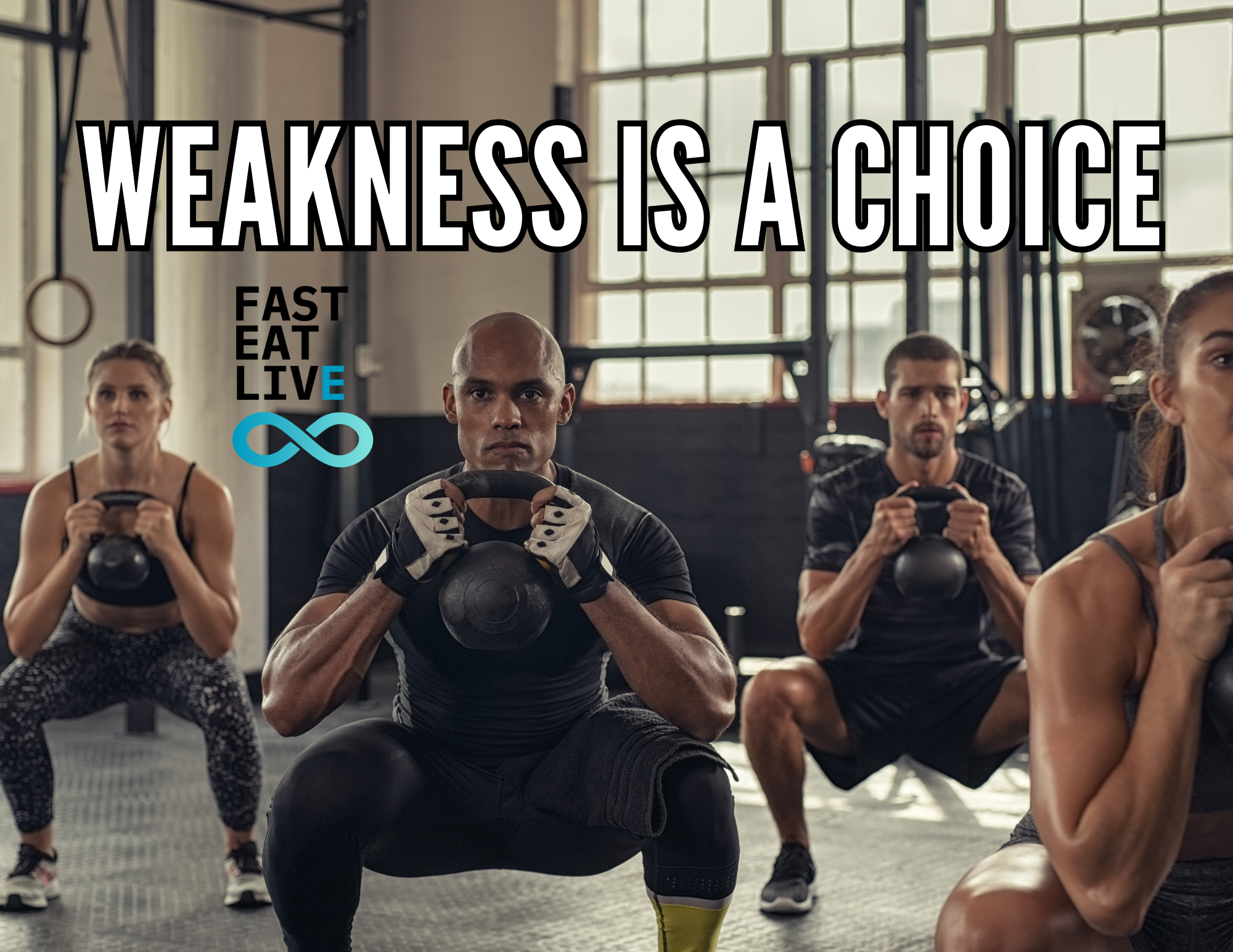
“Weakness is a choice.” That line hits people in the chest when I say it — not because it’s harsh, but because it’s true. Let’s clarify something immediately: weakness is not about illness you didn’t choose, tragedy you didn’t ask for, or hardship you didn’t deserve. In this context, weakness is about daily decisions. It’s about the slow drift. It’s about what happens when we stop choosing strength.
Every action has a direction. Every habit has a consequence. Every choice builds something — or erodes something. If you exercise, your heart grows stronger. If you lift, your muscles and bones grow denser. If you study and think deeply, your mind sharpens. If you pray, fast, and stand firm in your convictions, your spirit becomes resilient. Strength is not an accident. Weakness isn’t either. And today, we’re talking about one of the most dangerous silent drifts in modern culture: sarcopenia.
The Silent Thief: What Is Sarcopenia?
Sarcopenia is the scientific term for age-related muscle loss. It sounds clinical and distant, like something that only affects “old people.” It doesn’t. Muscle loss begins earlier than most think. By age fifty, the average adult loses roughly one to three percent of muscle mass per year, and strength declines even faster. If nothing is done, that loss compounds dramatically into your sixties, seventies, and eighties.
This isn’t cosmetic. It’s survival. Muscle is not just about looking athletic in a T-shirt. Muscle is metabolic currency. Muscle is your insurance policy against frailty. Muscle is your fall protection system. One of the leading causes of death in older adults is complications from falls — not necessarily the fall itself, but the downward spiral afterward: broken hips, surgery, immobility, infection, and systemic decline.
What protects you from that spiral? Muscle. Balance. Strength. Coordination. All of which are eroded by sarcopenia. The good news is that it’s not inevitable. The bad news is that it’s absolutely predictable if you do nothing.
Use It or Lose It — God Designed It That Way
Your body is brilliantly designed to adapt to demand. If you place a demand on it, it rises. If you remove demand, it shrinks. That’s not cruel; that’s intelligent design. If you lift heavy things, your body says, “We must stay strong.” If you walk daily, it says, “Mobility is necessary.” If you sit constantly, it says, “Apparently strength isn’t required anymore.”
The body always responds to the story you tell it through your actions. And this is where faith meets physiology. Scripture reminds us that our bodies are temples (1 Corinthians 6:19–20). Temples are not neglected structures; they are maintained, honored, strengthened. You don’t accidentally steward a temple well. You choose to. Weakness — spiritually, mentally, physically — comes when we stop engaging in the disciplines that keep us strong. Muscle is built through discipline.
Part 1: Protein — The Non-Negotiable
Protein is not a trend. It’s not a bodybuilding fad. It’s not optional. Protein is the structural foundation of your body — muscle, bone, organs, skin, enzymes, hormones, immune cells. All built from amino acids.
Protein is one of the three macronutrients, but it is primary in rebuilding the body’s frame. Fats and carbohydrates primarily provide energy. Protein provides structure. And here’s where most modern diets fail, they are overfed on energy and underfed on structure. Too many carbs. Too many fats. Not enough protein.
Inside Fast.Eat.Live., protein is non-negotiable. Our tribe follows a simple standard: one gram of protein per pound of goal bodyweight per day.
A 200-pound man aims for 200 grams.
A 150-pound woman aims for 150 grams.
It sounds high to those who have chronically under-consumed protein, but when protein rises, satiety increases, cravings decrease, body fat stabilizes, muscle retention improves, and metabolism strengthens.
Most importantly, you provide your muscles with enough amino acids to help prevent sarcopenia. Protein is not about getting “big.” It’s about not getting fragile. Fragility is not a virtue.
An added benefit appears quickly: when protein intake goes up, unnecessary carbs and fats tend to go down naturally because you feel satisfied. Not by force — by physiology. Protein regulates hunger hormones and stabilizes blood sugar. Over time, your body composition changes. More lean mass. Less excess fat. Better metabolic flexibility. That’s not vanity. That’s longevity.
Part 2: Resistance Training — The Stimulus for Strength
You cannot eat your way out of sarcopenia. You must stimulate muscle. Resistance training simply means applying force against load. Dumbbells, barbells, kettlebells, resistance bands, machines, weighted carries — anything heavier than your bodyweight qualifies.
You don’t need to train like a competitive athlete. You need consistency. Two to four resistance sessions per week focusing on compound movements, along with daily walking, is enough to dramatically change your trajectory. Walking reinforces cardiovascular health and joint mobility, but walking alone does not preserve maximal muscle. Muscle responds to tension.
When you lift, your body releases anabolic hormones that signal, “Stay strong.” When you don’t, those signals quiet down. It’s a basic use-it-or-lose-it principle. God designed muscle to respond to challenge, so challenge it.
There is also something deeply spiritual about strength training. Lifting reminds you that you can carry hard things. It reinforces that discomfort produces growth. James 1 teaches that trials produce endurance. Romans 5 reminds us that perseverance builds character. Muscle works the same way. Resistance builds resilience. Weakness grows in comfort. Strength grows in challenge. That applies to your soul as much as your body.
The FEL Strategy Against Sarcopenia
Inside Fast.Eat.Live., we approach this systematically through rhythm, not restriction.
Phase 1 – Fast: One weekly fast improves insulin sensitivity and metabolic switching, keeping your system efficient and hormonally responsive.
Phase 2 – Eat: High-protein, lower-carbohydrate days prioritize muscle repair and fat utilization. This is where we build.
Phase 3 – Live: Balanced macronutrients, community meals, celebration, and joy. Because sustainability matters. Isolation weakens people — physically and spiritually.
This isn’t a restrictive diet. It’s a rhythm. And rhythms create longevity.
Practical Steps Starting Today
First, calculate your protein target using one gram per pound of goal bodyweight. Second, prioritize whole-food protein sources such as grass-fed beef, pastured eggs, wild-caught fish, quality poultry, Greek yogurt, and clean protein supplementation if necessary. Third, lift weights two to four times per week, focusing on squats, hinges, pushes, pulls, carries, and rotational stability. Fourth, walk daily. Movement is medicine. Finally, stay in community. Strong tribes build strong individuals.
Weakness Is a Choice — But So Is Strength
Let me ask you directly: do you want to be seventy-five and independent? Do you want to carry your own groceries, travel freely, play with your grandchildren, stand tall in church, and walk confidently without fear of falling? Then build the frame now. Weakness does not suddenly appear at seventy-five. It was quietly chosen at forty-five.
You are not a victim of time. Aging is inevitable. Frailty is optional. You cannot stop the clock, but you can slow the decline. After more than thirty years of coaching, I can tell you this: the strongest older adults were not lucky. They were consistent. They stewarded their temple. They honored their design.
Your body was designed to move, lift, adapt, and respond. Honor that design. One day, decades from now, when you are standing tall, steady, and strong, you will know it wasn’t genetics.
It was a choice.
Stay strong, Livsters.
— Coach Scott